
How to Build Referral Relationships With Other Health Providers (Without the Awkward Cold Outreach)
If you've been sitting on the idea of reaching out to a local chiropractor, naturopath, or primary care office, you're not alone. It's one of the things I hear practitioners ask about constantly — and one of the things they put off the longest.
The goal is clear: you want aligned referral relationships with providers who see clients you could genuinely help, and who you could send clients to in return. The strategy makes total sense. The execution is where it gets murky.
Because here's what most practitioners actually wonder:
What do I even say? How do I explain what I do without sounding like I'm pitching? And how do I make sure they remember me after I leave?
This post walks you through a practical approach to building those relationships — including what to prepare, how to make first contact, and what to leave behind so they can actually refer with confidence.
Building referral relationships with other providers is one of the most sustainable ways to grow your holistic health practice — but most practitioners aren't sure how to approach it. This post walks you through what to prepare, how to make first contact, and how to go deeper than just asking for referrals.
Why Referral Relationships Are Worth Building (Especially Now)
The practitioners who have the strongest referral networks aren't necessarily the most credentialed or the most active on social media. They're the ones who made it easy for other providers to understand what they do and trust them enough to refer.
For holistic and functional practitioners — NTPs, FNTPs, health coaches, HTMA practitioners — this matters even more. The people you work with are often already seeing a conventional doctor, a chiropractor, a therapist, or someone else. Those providers may have no idea that nutritional therapy or HTMA work exists, or they may have a general sense of it but no frame for when or who to refer.
Your job isn't to convince them that your work is valid. It's to make it easy for them to see where you fit alongside the care they're already providing.
Start With the Right Mindset
The most common trap in building referral relationships is approaching it as a sales call. You're not selling anything. You're making a professional introduction that could benefit both of you — and more importantly, the clients you share.
The practitioners who get the warmest reception tend to lead with curiosity and genuine collaboration, not a pitch. They want to understand what the other provider does, who they see, and what gaps or frustrations come up for their clients. Then they share what they do in a way that makes the connection obvious.
Before you reach out, get clear on:
Who you actually work with. Not just "people who want to feel better" — but the specific concerns, symptoms, and situations that land in your practice. Fatigue, digestive issues, hormonal irregularity, chronic stress, poor sleep. The more specific you can be, the easier it is for another provider to picture a real client in their caseload who might benefit.
How your work complements theirs. This is the thing most practitioners forget to articulate. Other providers want to know: if I refer someone to you, how does that help my patients and my practice? You're not replacing what they do. You're supporting it between appointments through nutrition, lifestyle, accountability, and education.
What you can offer them. Some providers appreciate a one-page overview they can keep on file. Some are interested in a brief phone call or coffee. Some will be most receptive to educational content — a short workshop or lunch-and-learn for their team. Think about what feels natural for the type of practice you're approaching.
Making First Contact
There's no single right way to make a first introduction. The channel matters less than the approach. That said, here are a few that tend to work well.
Email: Low-pressure, easy for a busy provider to read when they have a moment. Keep it short — three to four sentences that explain who you are, who you work with, and why you're reaching out. Attach or include a one-page overview of your practice so they have something to reference. Don't try to say everything in the email itself.
Drop by in person: This works especially well for local chiro and naturopath offices, wellness studios, or integrative clinics. Bring a printed intro sheet and a genuine attitude — not a prepared sales speech. Ask if they have a few minutes to connect, or if you can leave something for the provider. Even if you don't get a conversation that day, you've made a tangible impression.
A referral or patient in common: If you both see the same client (with appropriate communication), that's often the warmest entry point. A simple note acknowledging the overlap and expressing interest in coordinating care can open a real conversation.
Mutual connection: A warm introduction from someone you both know is always better than cold outreach. If someone in your network is a patient at a clinic you want to connect with, ask if they'd be willing to mention your name.
Whatever your entry point, follow up. Once is rarely enough. A brief check-in email two or three weeks after your first contact is professional and expected, not pushy.
What to Leave Behind
This is the piece most practitioners underestimate. You can have a great conversation with a provider, and if you don't leave them something concrete to reference, you'll fade from memory within a week. Their practice is busy. They're thinking about their next patient.
A well-designed one-page intro handout does a lot of the work for you. It gives the other provider:
A clear summary of who you are and what you do
A concise list of the conditions and symptoms you work with
Language that explains how your work fits alongside theirs (not in competition with it)
Your contact info so they can reach you or refer easily
There are actually two versions worth having: one written for the provider themselves, and one written for their clients or patients — something a front desk coordinator can hand to someone who asks "do you know anyone who does nutrition work?" The client-facing version is less clinical and more focused on whether the person is a good fit for what you offer.
If you don't have a polished version of either of these, that's often what holds practitioners back. It's easy to feel like you need to write something from scratch, get it designed, make sure the language is right — and the whole thing gets pushed to the back burner.
We have a template set designed specifically for this that makes it much faster. The Practitioner Intro & Referral Template includes both the provider-facing and client-facing versions, fully editable in Canva, along with a customization guide and a sample outreach email you can adapt for your first contact. You can grab it here and have it ready to use the same day.
A Few Things That Actually Matter
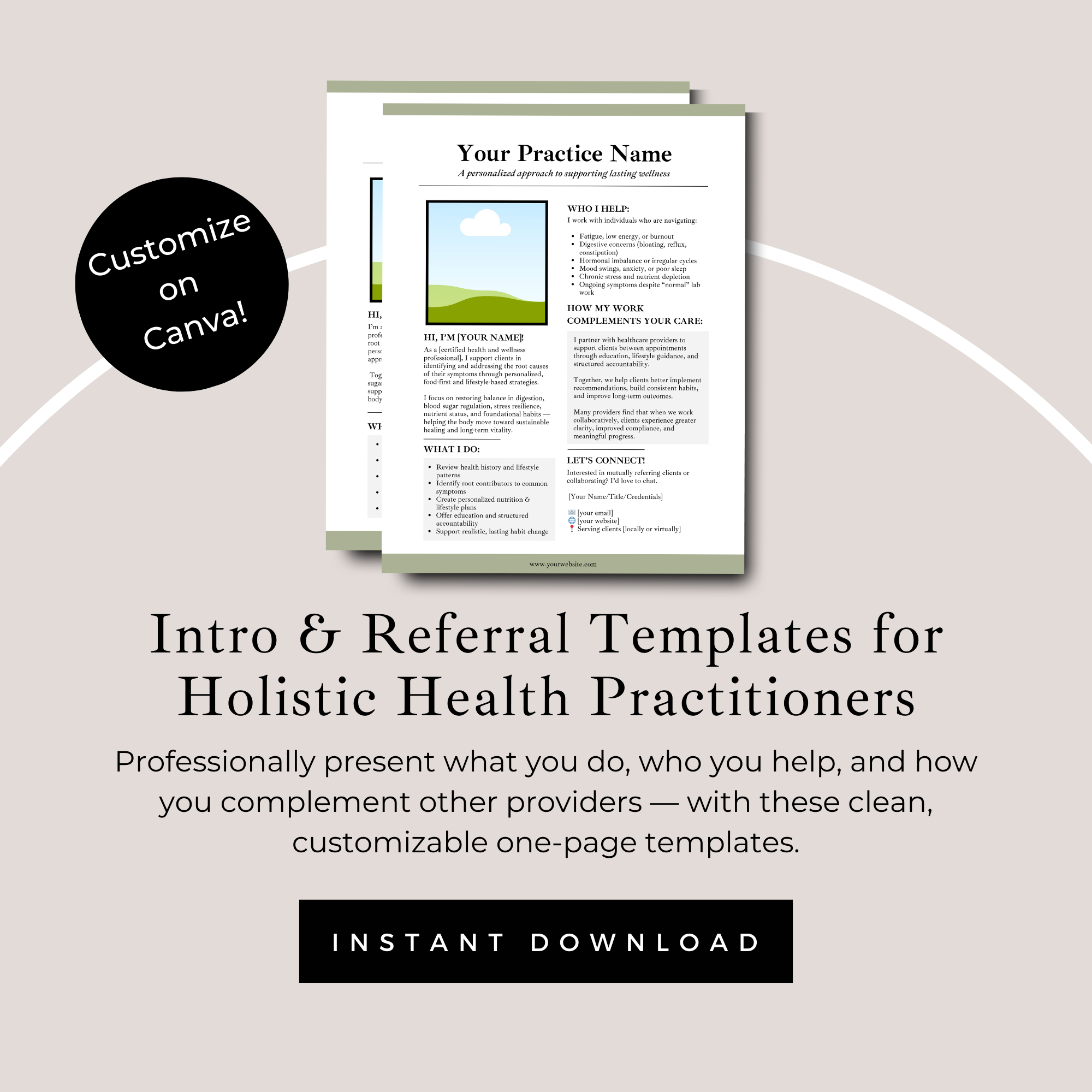
Editable Canva Outreach Sheet for Health & Wellness Professionals
Confidently introduce your practice — without awkward explanations, long emails, or overthinking what to say.
This professionally designed, fully customizable one-page intro sheet helps you clearly communicate:
• What you do
• Who you help
• How your services complement other providers
• How to connect or refer
Whether you're networking, collaborating, or building referral relationships, this polished handout helps you show up prepared and professional.
Perfect for health coaches, functional practitioners, nutrition professionals, and wellness providers who want to grow aligned referrals and position their work with clarity.
What’s Included
✔ Practitioner-Facing Referral Sheet (Editable Canva Template)
✔ Client-Facing Intro Sheet (Editable Canva Template)
✔ “How to Use This” Customization Guide
✔ Sample Referral Outreach Email Template
Both versions are fully customizable in Canva — swap in your brand colors, credentials, specialty, and contact details in minutes.
Designed to Help You:
• Build referral relationships with confidence
• Clarify your role alongside other providers
• Present your services professionally
• Save time when networking or collaborating
• Create a consistent first impression
How to Use It
• Attach to referral outreach emails
• Drop off at local clinics or wellness offices
• Bring to networking events or wellness fairs
• Include in your digital welcome packet
• Share during collaboration or discovery meetings
Why Practitioners Love It
• Clean, professional layout
• Easy to customize
• Broadly adaptable to different credentials
• Saves hours of writing and formatting
• Helps you feel prepared and positioned
Bonus Tip
Pair this template with one of our educational presentation decks to offer short workshops or staff trainings — a powerful way to build trust and strengthen referral relationships.
Licensing
This purchase includes a single-user license for use within your own practice. You may customize and share the materials with your clients and professional contacts. Resale, redistribution, or sharing of editable files is not permitted. For educational purposes only. Not medical advice.
Be specific about who you help. Vague descriptions ("I help people feel their best") are easy to forget. Specific ones stick. "I work with women dealing with fatigue, hormonal irregularity, and digestive issues who haven't gotten answers from conventional labs" is something a provider can file away and recall when they see a patient with exactly that presentation.
Don't oversell the collaboration upfront. You're not asking them to enter a formal partnership or put your name on their wall. You're just introducing yourself and letting them know you exist. Keep the ask small at first — maybe it's just "keep my contact info on file" or "feel free to reach out if you have a patient who might be a fit."
Follow through if they do refer. This sounds obvious, but it's how the relationship actually gets built. A brief note back to the provider (with any necessary client authorization) letting them know you connected and how it went goes a long way. It shows you're professional and that referring to you is a safe bet.
Give it time. Referral relationships aren't usually built in one meeting. They develop over months of consistent, low-key visibility. Show up at a local wellness event they're at. Check in every few months. Send something useful occasionally — an article, a resource, an invitation to a free workshop you're hosting.
Ways to Go Deeper Than Referrals
The strongest collaborative relationships aren't built on "send me your clients and I'll send you mine." They develop when another provider genuinely understands your work and has seen how it supports their patients. A few ways to get there:
Offer a short educational workshop or lunch-and-learn. This is one of the most effective things you can do, especially with chiropractic offices, integrative clinics, or functional medicine practices that already have a team around health and wellness. You're not asking for anything — you're offering to come in and share something useful. A 20-30 minute presentation on something like the gut-brain connection, the basics of mineral balance, or how nutrition supports the conditions they commonly treat can open a lot of doors. It positions you as a resource, not a competitor.
If the idea of putting together a presentation feels like another thing to build from scratch, a done-for-you educational deck can make this a realistic option instead of a someday plan. Pair it with your intro handout and you show up looking prepared and professional, even if you've never done something like this before.
Become a go-to educational resource. You don't have to do a formal presentation to be useful. Sending a provider an article relevant to something they mentioned, sharing a resource their clients might find helpful, or checking in when you come across something in your practice that relates to what they do — these small touches keep you on their radar in a genuinely valuable way. Over time, being the person who consistently shows up with useful information is more memorable than a single well-executed introduction.
Explore co-created content or events. If the relationship gets to a point where there's real alignment, some practitioners find success doing a joint workshop or community event together, co-writing something for each other's audiences, or cross-promoting in newsletters or social media. This is a longer-term play, but it's worth keeping in mind as a possibility — especially if you're both trying to reach the same community.
Ask what their clients struggle with. One of the most disarming things you can do in an early conversation is ask what comes up for their patients that they feel limited in addressing. Not so you can immediately offer yourself as the solution, but because it opens a real conversation. Often the answer will reveal exactly the kind of support you provide — and the connection becomes obvious without you having to sell it.
The through-line in all of these is that you're showing up to give, not to get. Referrals tend to follow that naturally.
The Bigger Picture
Building referral relationships is a long-term strategy, not a quick-win tactic. But it's one of the most sustainable ways to grow a practice, because aligned referrals come pre-qualified. The other provider has already done the initial trust-building with that client. By the time someone comes to you from a referral, they're usually ready to engage.
The practitioners who do this well aren't the most extroverted or the most salesy. They're the ones who made it easy. Who showed up with a clear, professional introduction. Who left something concrete behind. Who followed up and followed through.
If the "what do I actually bring with me" question has been holding you back, that's genuinely the easiest part to solve. Start there and let the rest follow.
Looking for a simple, done-for-you way to introduce your practice to other providers? The Practitioner Intro & Referral Template gives you both a provider-facing and client-facing handout, fully editable in Canva, plus a sample outreach email to use for first contact. Shop the template here.
